
First Steps of Growth · Love & Exploration
Early Childhood Division: Embark on Your First Steps of Growth with Love and Exploration.
Manila Xiamen International School (MXIS) Kindergarten serves children aged 3–6 with three levels of early education: Junior (3–4), Middle (4–5) and Senior (5–6) Classes. Rooted in our philosophy “Cherish Childhood Innocence, Inspire Natural Disposition, Integrate Eastern and Western Perspectives”, we foster curiosity, concentration and cross-cultural sensitivity within a safe, warm, inclusive environment, building a strong foundation for IB PYP learning.
Message from the Early Childhood Section Head

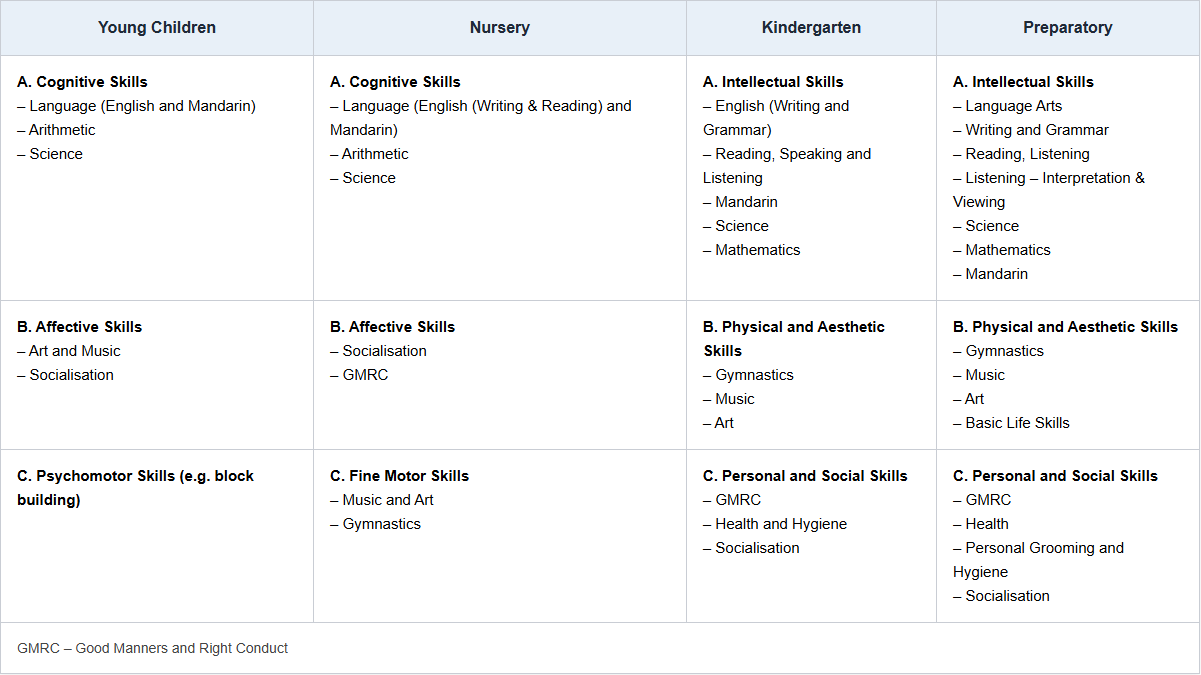
The Preschool Programme offers courses for toddlers, nurseries, kindergartens and pre-primary levels. The curriculum prepares children in reading, language, writing, mathematics, science, health, manners and proper conduct, music, art and physical education. It addresses the holistic needs of young learners by striking a balance between traditional learning tasks and 21st-century learning tasks. Subjects delivered in the preschool programme are elaborated and reinforced to help students build foundations in numeracy, literacy and values.
Upon completion of the pre-primary level, preschool children will develop basic social skills and knowledge through creative play and social interactions inspired by MXIS S.E.L.F. qualities — Self-motivation, Exploration, Love & Care, Fun — preparing them for formal primary education.

IB PYP Initiation • Bilingual Immersion • Holistic Development
Centered on the IBO PYP transition framework for early years and primary, we integrate China’s Guidelines for the Learning and Development of Children Aged 3–6 to create an inquiry-based, play-oriented bilingual curriculum. Aligned with international educational benchmarks while rooted in Chinese cultural initiation, it covers six core modules:
1. Language Initiation (Bilingual)
Language initiation aims to build young learners’ basic English listening and speaking skills and develop Chinese expressive abilities, enabling children to enjoy language and gain confidence in bilingual communication through natural interactions. We adopt a co-teaching model with local and international educators. International teachers lead English sessions while Chinese teachers facilitate Chinese lessons and daily communication, ensuring a minimum of 6 hours of bilingual immersion daily. Contextual activities including nursery rhymes, picture books, drama and story chain games are integrated into classes for natural language acquisition. Cross-cultural language games such as rhymes and finger plays from various countries further inspire children’s curiosity for language exploration.
2. Inquiry-Based Thematic Activities
Inquiry-Based Thematic Activities safeguard young children’s curiosity and inquisitiveness, fostering observation, hands-on skills and basic problem-solving awareness for knowledge construction through self-directed exploration. Three core inquiry themes are designed each semester, covering child-relevant areas such as Nature & Life, My Body, Community & Family, and Culture & Festivals. Using project-based inquiry as the primary approach, we organize outdoor observations, handcraft creation, group discussions and simple experiments around each theme, including practical tasks like campus plant observation journals and handmade festival gifts. The classroom also features dedicated inquiry corners stocked with abundant teaching aids and materials to support children’s free choice and independent exploration.。
3. Chinese Cultural Initiation
Chinese Cultural Initiation introduces young children to the charm of traditional Chinese culture and local Minnan characteristics, nurturing initial cultural identity and national pride and laying the groundwork for cultural confidence. Our traditional festival curriculum offers immersive hands-on experiences including pasting Spring Festival couplets, making zongzi for Dragon Boat Festival, crafting mooncakes for Mid-Autumn Festival and rolling tangyuan for Winter Solstice. We incorporate Minnan nursery rhymes, introductory Chinese calligraphy, traditional paper-cutting and shadow puppet show appreciation. Field trips to local sites such as Zengcuo’an Cultural Village, Nanputuo Temple and the coastal ecosystem along Huandao Road enable children to experience the unique charm of regional culture within authentic settings.
4. Arts & Aesthetic Cultivation
Arts & Aesthetic Cultivation nurtures young children’s imagination and creativity while enhancing their aesthetic perception. Children express themselves freely and build confidence through artistic creation. The curriculum includes music movement, instrumental exploration, painting, clay modelling, handcrafts, dance and dramatic play. Regular Early Years Art Exhibitions offer platforms for children to showcase their works and grow through recognition. Cross-cultural art experiences are also introduced, such as African drums, Western oil painting and Japanese origami, to broaden their aesthetic horizons.
5. Physical Education & Wellbeing
Our curriculum focuses on boosting young children’s physical fitness, cultivating interest in sports and awareness of rules, and helping them build healthy living habits and self-care abilities. We deliver fundamental motor-skill training covering running, jumping, crawling, climbing and balance. Signature activities include swimming initiation (in our exclusive heated children’s pool), small-ball games, outdoor fitness challenges and introductory golf experiences. Health routines are embedded into lessons to guide children in learning handwashing etiquette, tidying belongings independently, maintaining balanced diets and keeping regular daily schedules.
6. Social & Emotional Development
The Social & Emotional Development curriculum helps young children learn to communicate, share and cooperate, build secure attachments and a sense of community, and foster core character traits of kindness, honesty, courage and respect. We guide social skills through scenario simulations and shared storybook reading, supporting children to express emotions and resolve peer conflicts. Group cooperative games, collective birthday celebrations and peer-support activities cultivate a sense of belonging. Themed sessions and practical activities centered on core values of kindness, honesty, courage and respect weave character education naturally into daily school life.
Catering to Young Learners’ Developmental Needs
Small-Class Teaching & Individualised Attention:
Class sizes are capped at 15–20 children with a 1:5 student-teacher ratio. Every young learner receives ample teacher attention. Educators deliver personalised guidance aligned with each child’s temperament, interests and developmental pace.
Play-Based Learning & Joyful Initiation:
Rote teaching is not adopted. Knowledge is embedded within play. For example, block-building activities develop spatial awareness; role-plays teach social norms; outdoor scavenger hunts introduce natural science concepts. Children learn through play and enjoy the learning journey.
Immersive Bilingual Environment:
Beyond dedicated language lessons, bilingual interactions run through daily communication, playtime, meals and rest periods. Chinese educators focus on Chinese expression and cultural nurturing, while international teachers prioritise English listening & speaking and global awareness, enabling children to naturally adapt to bilingual exchanges.
Smooth Primary Transition:
A PYP Early Years-Primary bridging programme is available for Senior Kindergarten. Activities including Primary Division campus tours, classroom taster sessions and schoolbag organisation practice prepare children psychologically, habitually and academically for primary school, easing transition anxiety.
Professionalism & Compassion
Safe, Warm and Inclusive
Dedicated Premises
The Early Years section occupies a separate campus, managed independently from Primary and Secondary divisions. Facilities include a two-storey play castle, sandpit, water play area and green lawn as well as indoor activity rooms. All equipment features rounded edges and eco-friendly materials, with anti-slip cushioned flooring to safeguard children during activities.
Daily Schedule
08:00-08:30 Arrival Check-in + Morning Play
08:30-09:00 Breakfast
09:00-10:30 Bilingual Inquiry Activities (Language / Math / Science)
10:30-11:00 Outdoor Play & Snack Time
11:00-11:40 Arts / PE Sessions
11:40-12:20 Lunch
12:30-14:30 Nap Time
14:30-15:00 Wake-up & Snack Time
15:00-16:00 Specialist Lessons (Chinese Culture / Cross-cultural Experiences)
16:00-16:30 Outdoor Exploration / Free Play
16:30-17:00 Departure Sharing & Reflection
Signature Activities:International Culture Day, Family Sports Day, Themed Festival Parties, Graduation Ceremony for Young Learners, Campus Gardening Day, Fire Drills and Little Chef experiences. Children broaden their horizons and gain joy through these diverse activities.
Nutritional Catering:The canteen creates customised nutritious menus for young children following the principles of low salt, low sugar, low fat and balanced nutrition. Fusion Eastern-Western meals are served to accommodate dietary requirements of children of various nationalities. Two daily snacks such as fruits, yoghurt and pastries are provided. All ingredients are traceable to guarantee food safety.
Age Range:
Nursery Class: 3 years old (as of 31 August of the academic year)
Pre-K Class: 4 years old (as of 31 August of the academic year)
Kindergarten Class: 5 years old (as of 31 August of the academic year)
Eligible Applicants:
Open to all applicants
Admissions Process:
Campus Tour → Submission of Application Documents → School Review → Early Years Visit (observation of adaptability and communication skills) → Parent Interview → Offer Issuance → Enrolment Procedures
Notes:
The Early Years Visit is a non-academic observation focusing on children’s social skills, emotional stability and level of engagement in activities.


